Dinesh Reddy Kasu
Principal Fullstack Engineer at Fidelity Investments
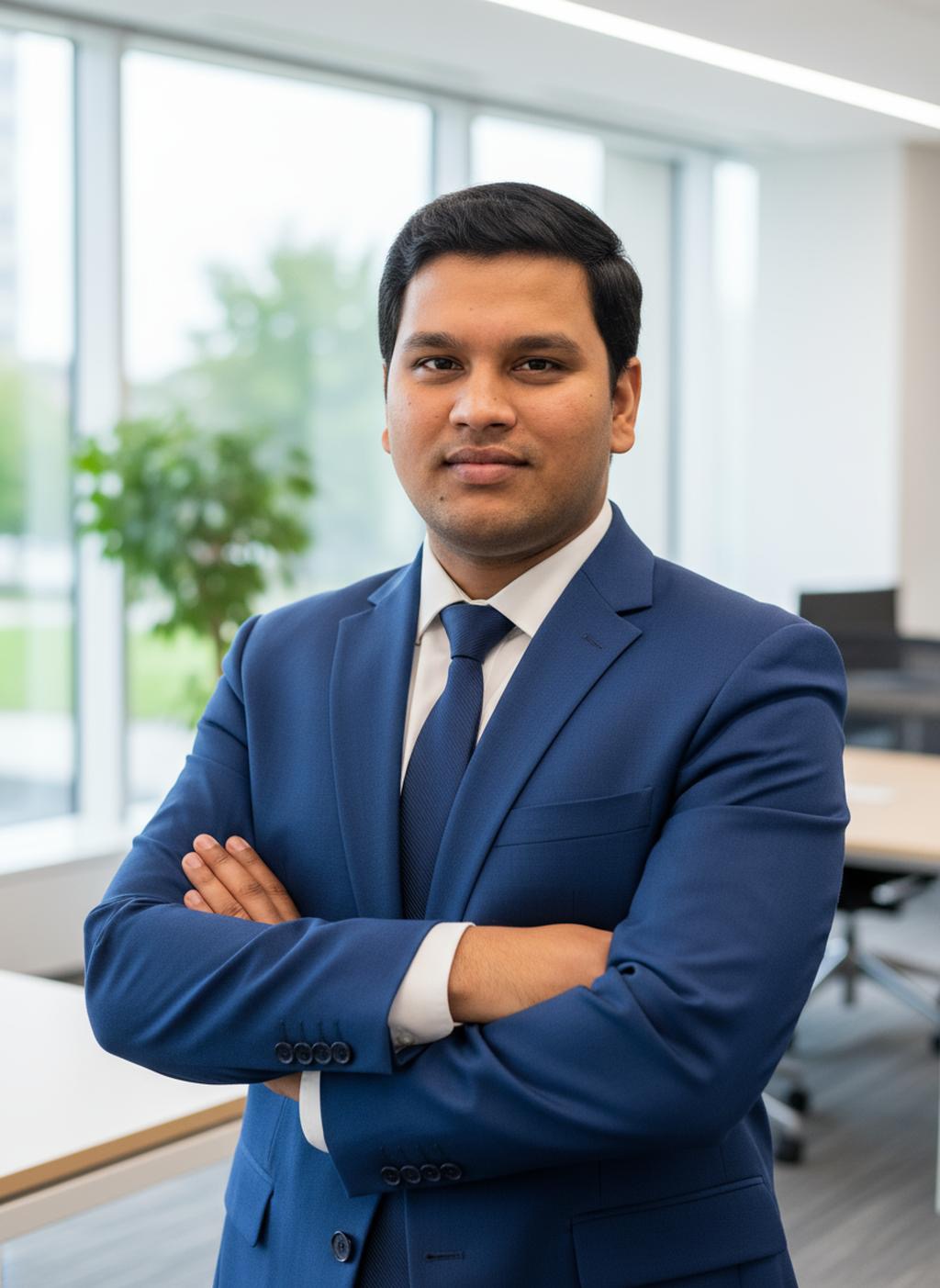
FELLOW MEMBER
Dinesh Reddy Kasu has built a career over more than 13 years around the design and delivery of enterprise-scale digital platforms in financial services and applied AI. His work spans full-stack engineering, platform architecture, cloud-native modernization, and conversational AI systems, with a recurring focus on building customer-facing software that must be scalable, resilient, secure, and usable in highly regulated environments. Across organizations including Fidelity Investments, Capital One, Bank of America, and Wright State University, his professional record shows a consistent pattern: he works on systems where digital experience, operational reliability, and intelligent automation intersect.
A defining feature of his career is the combination of traditional enterprise software engineering with more recent work in conversational AI. That combination is especially relevant in the current financial-services landscape, where firms are increasingly exploring AI-powered customer experiences while still operating under strong expectations around security, privacy, and reliability. Fidelity has publicly signaled interest in AI-enabled client experience, and in 2025 Fidelity International launched “Freya,” a conversational AI interface designed to support customer needs with strong safety controls and human oversight. While that product is not the same as the internal platform he describes, it provides useful public context for the significance of conversational AI initiatives in the Fidelity ecosystem.
Within that broader setting, Dinesh Reddy Kasu’s work on CogStore is notable because it appears to have focused not merely on building a chatbot, but on creating a reusable enterprise platform for conversational AI development across web, mobile, and voice channels. The most significant part of that contribution is the platform design itself: a low-code or no-code approach that allowed non-engineering teams to participate in virtual-assistant creation, supported by graph-based workflow modeling and integration with large language models. That kind of system is architecturally meaningful because it shifts conversational AI from isolated engineering projects into a reusable enterprise capability. Even though the exact internal implementation is proprietary, the structure he describes is consistent with the broader direction of enterprise AI tooling, where governed platforms increasingly sit between raw models and customer-facing experiences.
His work on Fidelity’s Helios Experience Platform reflects another important part of his profile: digital-experience modernization. Fidelity’s recent public launch of Fidelity Trader+ emphasized a more modern technology stack, cross-device experience continuity, and faster adaptation to customer needs across web, desktop, and mobile applications. That public direction provides useful context for the importance of unified digital-experience layers inside Fidelity’s broader product environment. In that setting, Dinesh Reddy Kasu’s role in building reusable frontend and backend services, improving modularity, and strengthening CI/CD and monitoring suggests meaningful contribution to the platform discipline that enables more consistent experiences across customer channels.
His earlier work at Capital One also fits a credible public architecture pattern. Capital One’s own engineering materials describe the company’s use of microservices and cloud-native architecture as part of broader modernization efforts, emphasizing scalability, resilience, observability, and loosely coupled systems. Those materials also stress that migrating from monoliths to microservices requires disciplined architectural judgment rather than trend-following. In that context, Dinesh Reddy Kasu’s work on a card digital servicing platform appears well aligned with a real and public engineering model at Capital One: cloud-native, microservices-based customer servicing platforms supported by CI/CD, monitoring, and gradual frontend modernization.
His work at Bank of America on lending risk technology similarly fits a broader public digital-banking pattern. Bank of America publicly highlights the scale of its digital client interactions and ongoing investments in AI and digital innovation, and it also offers a substantial Digital Mortgage Experience that reflects the importance of online borrowing workflows. Although the exact internal lending-risk platform he describes is not publicly documented in the sources reviewed, the architectural patterns he cites—real-time services, batch processing, scoring pipelines, and portfolio-level recalculation—are fully consistent with how large financial institutions manage lending and mortgage risk systems.
His earlier work on Cyber Briefs at Wright State University adds a different but still relevant dimension to his record. Wright State publicly announced Cyber Briefs in 2014 as a site designed to aggregate and publish cybersecurity news and intelligence, with dozens of stories posted daily and searchable archives intended for broad public use. That external record supports the significance of the platform context he describes and shows that even early in his career he was contributing to technically meaningful public-facing systems that combined backend integration, publication workflows, and content accessibility.
Taken together, Dinesh Reddy Kasu’s career reflects a technically coherent and progressively stronger record in enterprise systems engineering. His work spans customer-experience platforms, conversational AI, cloud-native servicing systems, risk-processing environments, and public information platforms. What stands out most is not a single technology stack, but a consistent pattern of building systems that transform complex requirements into durable, user-facing digital capabilities. In regulated financial environments especially, that kind of work has high practical value because it affects customer trust, service continuity, and the ability of organizations to evolve their digital offerings responsibly.