Raghu Chukkala
Principle Software Engineer at Verizon
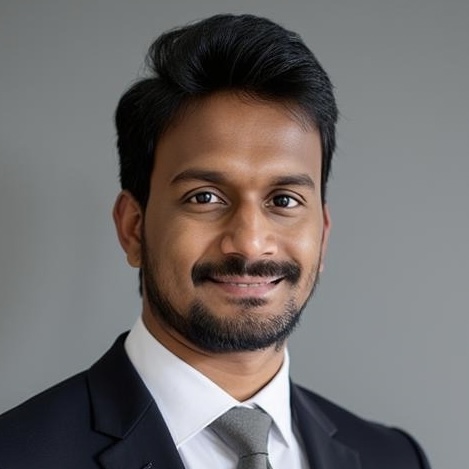
FELLOW MEMBER
Raghu Chukkala’s career reads like a chronicle of how customer communication in telecom has shifted from scripted support flows to intelligence-driven, omnichannel conversation systems. Across 14 years in software engineering—with the last six centered on conversational AI—he has built and modernized platforms that sit directly in the critical path between millions of subscribers and the services they rely on every day.
In his recent work at Verizon, Chukkala has operated where messaging scale, latency, and customer trust collide: asynchronous support across Apple Messages for Business, RCS, SMS, and WhatsApp for more than 10 million monthly users. The core engineering challenge is not simply routing messages; it is maintaining continuity across channels and devices, ensuring escalation to agents happens cleanly, and doing so with measurable improvements in customer experience and operational efficiency. His architecture work includes designing the LivePerson escalation pipeline and optimizing the end-to-end conversation journey to reduce average handle time by 40%, while cutting repeat transfers by 28% by retraining and refining Dialogflow intent models at enterprise depth (3,000+ intents and 500+ entities). To sustain performance under peak load, he combined streaming telemetry (Kafka feeding Kibana dashboards) with aggressive latency control using Redis—reporting a 65% latency reduction—while driving higher containment (45%) and strong intent accuracy (89%).
That platform trajectory is consistent with his earlier leadership on Verizon’s OneBot program (2021–2024), where his focus expanded from scale to sophistication: multilingual and GenAI-enhanced experiences designed to reduce fallouts, increase containment, and improve sentiment. Under his technical leadership, OneBot grew to engage roughly five million monthly users and reported material improvements in containment (28%→43%), sentiment (62%→85%), and intent accuracy (to 92%), alongside a 50% reduction in agent handling time—outcomes that reflect not just model tuning, but disciplined conversation design, caching strategy, and resilient service integration.
Before that, Chukkala delivered applied AI in a different modality: visual troubleshooting. He built and trained computer-vision-powered support flows (TensorFlow/OpenCV) that allowed customers to diagnose router and home-internet issues by submitting smartphone images—scaling to around one million users, achieving 90% diagnostic accuracy, and reducing escalations by 25%. And earlier still, he established full-stack and mobile engineering breadth—cross-platform apps (Flutter, React Native, Kotlin Multiplatform), microservices (REST/GraphQL), and immersive experiences (AR/VR)—paired with foundational automation engineering work in financial services, where rigorous test architecture and defect detection are business-critical.
Taken together, the pattern is clear: Chukkala repeatedly operates at the intersection of customer-facing reliability and applied AI—where conversational design decisions translate into measurable reductions in handle time, transfer rates, and escalation load, and where the platform must be engineered to be fast, observable, and safe at scale.