Rakesh Kumar Jha
Manager Application Delivery at DXC Technology
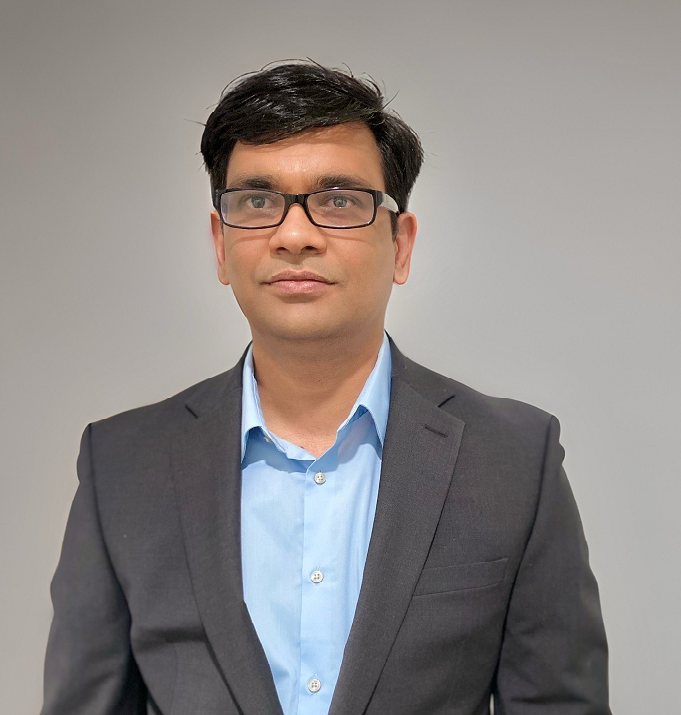
FELLOW MEMBER
Rakesh Kumar Jha has built a long and technically significant career in enterprise technology leadership, with more than 21 years of experience focused on fintech architecture, insurance platforms, application modernization, and workflow automation. His professional record reflects sustained work in some of the most demanding areas of enterprise computing, including life and annuity policy administration systems, financial reconciliation, disbursement processing, compliance automation, and hybrid mainframe-cloud transformation. Across these domains, his career has been defined by a consistent ability to convert legacy-intensive environments into scalable, secure, and automated platforms aligned with strict financial governance and regulatory requirements.
A central theme in Jha’s work is modernization with measurable business consequence. At DXC Technology, in his role as Solution Architect and Project Manager, he led the architecture of the Ledger and Disbursement System (LDS), an initiative designed to replace multiple legacy financial tools and mainframe-dependent systems with a unified internal platform. Built using Angular, Node.js, Python, SQL Server, and Power BI, the platform was designed as a configurable, cloud-ready, multi-client architecture that could support large-scale onboarding while minimizing migration overhead. His contributions included designing core ledger modules, implementing LDAP-based security and role-based access controls, creating automated approval workflows with audit traceability, and leading cross-functional agile teams. The initiative is projected to generate approximately $1.5 million in annual savings while reducing manual reconciliation and disbursement workflows by roughly 65%, illustrating the scale of both the technical and organizational impact.
Another major contribution at DXC was his leadership of the ILM PROD Disposal and Data Retention (DRD) Application, a centralized framework for secure data retention and disposal across 26 legacy insurance systems for a Fortune 100 insurer. This program addressed a complex governance and compliance challenge: the irreversible disposal of obsolete policy and claims data while maintaining full alignment with Information Lifecycle Management requirements. Jha architected a solution that automated identification, validation, purge execution, and certificate generation across heterogeneous systems, replacing fragmented manual compliance procedures. The result was an approximately 80% reduction in manual disposal coordination effort, along with the secure purge of around 400,000 records supported by rollback safeguards and durable audit-trace repositories. His leadership across more than 15 application teams ensured zero-error disposal audits and legally defensible compliance traceability.
Jha also drove modernization through the Common Remitter Tool (CRT), where he served as Solution Architect and Manager for a remittance ingestion, validation, and routing platform serving more than 60 institutional clients. In this system, he redesigned the batch orchestration layer, engineered validation frameworks, and integrated the platform with enterprise financial systems. The project’s most distinctive innovation was a dynamic recalculation engine for “Not in Good Order” records, allowing real-time correction through a graphical interface and reducing reprocessing cycles from hours to minutes. Combined with a validation framework supporting more than ten complex file formats, the redesign reduced manual operational workload by approximately 70%, saved an estimated $300,000 annually, and improved transaction validity rates and SLA performance.
In the Date Management Automation Tool (DMAT), Jha tackled another major source of enterprise dependency: reliance on a third-party date calculation engine that constrained policy lifecycle processing. Acting as Solution Architect and Manager, he led end-to-end architecture, C# development, SQL Server integration, and automation of control card generation for mainframe batch systems. The resulting configuration-driven engine was capable of calculating more than 150 complex policy dates and automatically generating mainframe control cards, eliminating recurring vendor licensing costs and reducing manual effort by more than 80%. By designing the platform with fully parameterized logic, he also enabled rapid onboarding of new date rules without code changes, demonstrating a form of architectural thinking oriented toward long-term sustainability rather than one-time cost reduction.
His contributions to financial process automation are further illustrated by the Custom Financial Reports (CFR) Upload Automation initiative at DXC. As Solution Architect and Technical Lead, he replaced manual, ticket-driven report uploads with a secure and automated modular web-based platform integrated with enterprise schedulers and secure file transfer systems. By embedding validation logic, approval workflows, and automated archival features, he transformed financial reporting into a traceable, schedule-driven process. This reduced financial input preparation effort by approximately 60%, while improving audit readiness, governance, and operational consistency across multiple insurance clients.
Earlier, at MassMutual, Jha served as Solution Architect and Lead Developer for the Grace Management System (GMS), a regulatory correspondence automation platform designed to support compliance across more than 50 U.S. states. He defined the architectural blueprint, developed a configuration-driven rule engine, and migrated correspondence logic from mainframe modules to a centralized service-based platform. The system’s innovation lay in enabling business users to modify regulatory logic without requiring code changes, which significantly increased agility in responding to state-level compliance updates. The platform reduced manual interventions by more than 70% while maintaining full traceability and audit readiness in a heavily regulated insurance environment.
Taken together, these projects reveal a professional whose work goes far beyond routine enterprise support or incremental optimization. Jha has repeatedly operated in high-risk, regulation-heavy financial environments where architecture decisions directly affect compliance, audit integrity, cost efficiency, operational continuity, and the modernization of legacy ecosystems. His record shows sustained leadership in enterprise-scale modernization, automation of compliance-critical workflows, reduction of mainframe dependency, and secure financial systems architecture.
For IICSPA Fellowship consideration, Rakesh Kumar Jha stands out as a professional whose career reflects technical depth, original architectural contribution, measurable financial and operational impact, and long-term influence on enterprise computing practices in the insurance and fintech domain. His work demonstrates the level of maturity, innovation, and sustained impact expected of a fellowship-level candidate.